Stop Chasing the Spark: How Slowing Down Actually Lights You Up
Here's something I've noticed about myself: the harder I try to force a good idea, the more it hides from me. I'll sit down at my desk, fully caffeinated, timer set, ready to create — and nothing. Absolutely nothing. But then I'll be in the shower, or folding laundry, or just staring out the window at a squirrel doing squirrel things, and boom. The idea shows up like it was waiting for me to stop looking for it.
Turns out, that's not just me being weird. That's actually how creativity works.
Your Brain Does Its Best Work When You're Not Watching
There's a concept in neuroscience called the default mode network — basically, it's the part of your brain that kicks on when you're not actively focused on a task. For a long time, scientists thought this was just your brain idling, like a car at a red light. But more recent research suggests the opposite: the default mode network is where your brain makes unexpected connections, synthesizes information from different experiences, and generates those out-of-nowhere ideas that feel like magic.
In other words, your brain is doing some of its most creative work precisely when you think it's doing nothing.
The problem? We've trained ourselves to be suspicious of stillness. If we're not visibly producing something, we feel like we're failing. We scroll instead of sit. We fill every gap with noise. And we accidentally shut down the very mental processes that would've handed us our best ideas on a silver platter.
Productive Procrastination Is a Real Thing (And It's Different From Doomscrolling)
Let me be clear about something, because I know what you're thinking: this isn't permission to spend four hours on TikTok and call it creative incubation. There's a real difference between intentional slowness and mindless consumption, and that difference matters a lot.
Mindless scrolling is passive. It feeds you content at a pace you never chose, in an order you didn't design, optimized to keep you hooked rather than nourished. Your brain isn't wandering freely — it's being led on a leash.
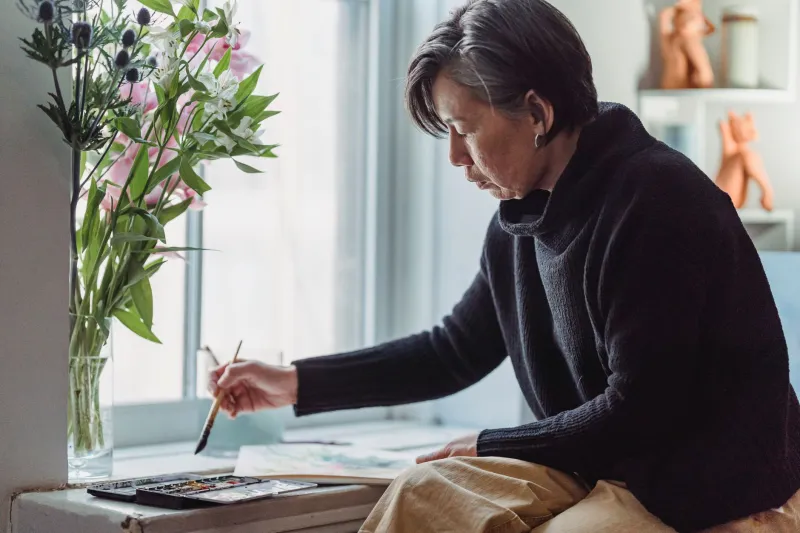
Intentional slowness looks different. It's a walk where you leave your phone at home. It's sitting with a cup of coffee and genuinely watching the morning light change. It's knitting or doodling or gardening — activities that occupy your hands but leave your mind to roam. That kind of slowness is an active choice, and it creates the mental spaciousness where creative breakthroughs actually happen.
The Creators Who Figured This Out
Some of history's most celebrated creative minds were, frankly, notorious for what looked like laziness from the outside.
Agatha Christie, who wrote 66 detective novels and is still the best-selling fiction writer of all time, famously said she did her best plotting while washing dishes. Not outlining. Not drafting. Washing. Dishes. She described the kitchen sink as her most productive workspace.
Lin-Manuel Miranda has talked openly about how Hamilton came to him while he was on vacation — a trip he almost didn't take. He picked up Ron Chernow's biography of Alexander Hamilton at an airport, started reading on the beach, and the whole thing started crystallizing in his head while he was supposedly doing nothing productive at all.
Even Darwin built long, slow walks into his daily routine as a deliberate creative practice. He had a thinking path at his home in England that he'd lap over and over, just... thinking. Not writing. Not researching. Walking and letting his mind do what minds do when you give them room.
These aren't flukes. These are patterns.
The Turtle Approach to Creative Work
I've always felt a kinship with turtles — which, if you've been around this site for more than five minutes, you already know. There's something deeply appealing about an animal that carries its home on its back, moves at its own pace, and doesn't apologize for either of those things.
That's the energy I try to bring to my creative work. Not slow for the sake of slow, but unhurried on purpose. Giving ideas time to develop before I demand they perform. Letting a concept sit in my head for a few days before I try to execute it. Trusting that the work is happening even when I can't see it yet.
Here's a practice that's genuinely changed things for me: I keep what I call a slow ideas list. It's not a to-do list. It's not a project tracker. It's just a running note on my phone where I jot down half-formed thoughts, images that struck me, questions I don't have answers to yet. I don't pressure myself to do anything with them. I just collect them.
And then, almost without fail, a few weeks later I'll look at that list and two things that seemed completely unrelated will suddenly click together into something I actually want to make.
Giving Yourself Permission to Not Know Yet
Our culture is obsessed with output. Productivity hacks. Morning routines. Side hustles. The pressure to always be making, always be shipping, always be doing something you can show people — it's relentless, and it's genuinely bad for creative work.
The irony is that the creators who produce the most interesting, lasting work are often the ones who've figured out how to protect their unproductive time. They guard their slowness like it's a resource, because it is.
You don't have to be Agatha Christie or Lin-Manuel Miranda to apply this. You just have to be willing to sit with not-knowing for a little while. To take the walk. To wash the dishes without a podcast. To let your brain wander somewhere you haven't planned.
The spark isn't hiding from you. It's just waiting for you to stop chasing it long enough to let it catch up.
And trust me — it will.