Build a Mood Board That Actually Does Something: My Process for Creating an Inspiration Wall With Real Creative Power
I have a confession: I spent years making mood boards that looked incredible and did absolutely nothing for me creatively.
They were beautiful. Color-coordinated. Perfectly balanced. And completely useless the moment I sat down to actually make something. They were more like decorating exercises than creative tools — aesthetic for the sake of aesthetic, with no real connection to the work I was trying to do.
It took me a while to figure out the difference between a mood board that looks inspiring and one that actually is inspiring. Spoiler: the gap between those two things is wider than you'd think, and it has almost nothing to do with how pretty the images are.
Why Most Mood Boards Fall Flat
Here's the problem with the standard Pinterest-dump approach: you're collecting images you like rather than images that mean something specific to the project at hand. There's nothing wrong with liking things. But a board full of beautiful, vaguely cohesive images is just wallpaper. It doesn't push you anywhere.
A genuinely useful mood board is more like a conversation with yourself. It captures not just what you're drawn to visually, but why — what feeling you're chasing, what emotional territory you're trying to map, what questions you're trying to answer through your work.
Once I started building boards with that framing, everything changed.
Go Physical If You Can (Seriously)
I know digital is convenient. I use digital boards too — Milanote is my go-to when I need something portable. But there is something irreplaceable about a physical inspiration wall.
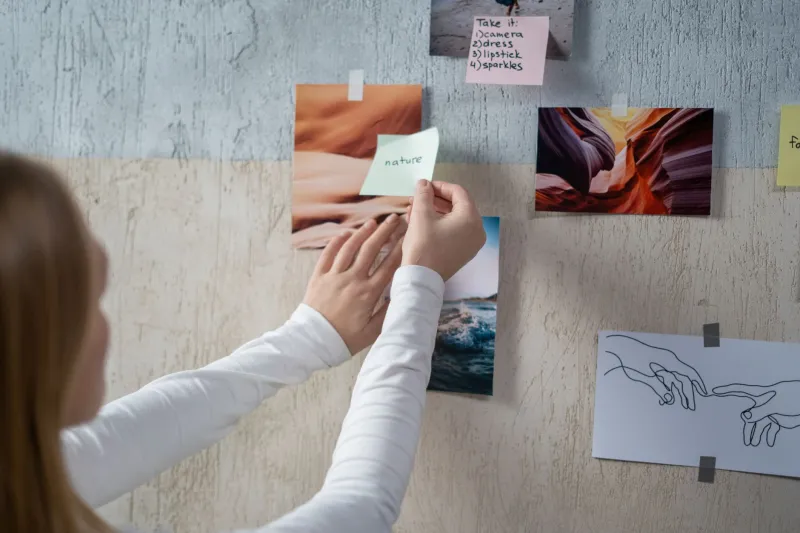
When you print something out, cut it from a magazine, or pin a postcard to a board, you're making a physical commitment to that image. You're saying: this matters enough to occupy real space. And because physical boards exist in your environment rather than behind a screen, you encounter them passively — while you're making coffee, while you're stretching, while you're doing literally anything else. That passive exposure is where a lot of creative breakthroughs actually happen.
My current setup is a large corkboard I found at a thrift store for four dollars and a half-used pack of pushpins. Nothing fancy. The magic is in what goes on it.
Where to Source Material That Feels Personal
This is the part most tutorials skip, and it's where the real character of a mood board comes from.
Thrift stores and used bookshops are gold mines. Old National Geographics, vintage design annuals, outdated interior design magazines, paperback novels with beautiful cover art — all of it costs almost nothing and contains imagery you genuinely won't find on a stock photo site. The slightly aged quality of older print photography has a texture and warmth that digital images rarely replicate.
Printed fan art is something I've been incorporating more lately, and it's become one of my favorite sourcing strategies. There are incredible artists on Ko-fi, Etsy, and DeviantArt who create work around the stories and characters that matter to me. Printing a small piece of fan art and pinning it to my board isn't just visually interesting — it's a reminder of the emotional resonance I'm trying to reach in my own work. It connects my creative practice to the creative community I'm part of.
Your own old work deserves a spot too. Sketches, doodles, color tests, even things you made years ago that you don't totally love anymore — they're evidence of where you've been and can point toward where you're going.
Organize by Feeling, Not Just Color
Color-coordinated boards look amazing in photos. But when you're staring at a blank canvas at 11pm wondering what to do next, color harmony isn't what you need. You need emotional direction.
I organize my boards in loose emotional clusters. One corner might be all about quiet tension — images that feel held-back, restrained, almost uncomfortable. Another section might be joyful chaos — bright, busy, a little overwhelming on purpose. A third might be things that feel like longing, which is weirdly hard to define but very easy to recognize when you see it.
These clusters become reference points. When I'm working on something and I need to check in with what I'm actually going for, I look at the relevant cluster and ask: does what I'm making feel like this? If not, what's off?
How to Actually Use the Board When You're Stuck
Here's the ritual I've developed for creative blocks, because just having a mood board isn't enough — you have to know how to use it.
When I hit a wall, I step back from whatever I'm working on and spend five to ten minutes just looking at the board. Not analyzing. Not problem-solving. Just looking, the same way you'd look out a window. I let my eyes wander and notice what pulls my attention.
Nine times out of ten, I land on something I haven't really seen in a while — an image that got buried under new additions or that I stopped noticing because it became familiar. That rediscovery almost always sparks something. A question, a connection, a tiny shift in direction that opens up the work again.
The board works because it holds your intentions when your brain can't. It's a physical record of what you were trying to do before the doubt crept in.
Keep It Alive
A mood board isn't a finished object. It's a living document. Add to it when something new catches your attention. Take things down when they stop speaking to you. Let it evolve with your work.
The best creative tool isn't the most sophisticated one — it's the one you actually return to. Build something messy and personal and genuinely yours, and I promise it'll do more for your creativity than any perfectly curated grid ever could.